


FROM OUR FLAVORS TO YOUR FINISHED PRODUCTS
Lucie LevêqueRegulatory Affairs Manager
At PROVA, we work to impart and enhance taste and aroma, mask aftertastes, or standardize flavors using synthetic or natural flavors. Committed to natural food solutions, we have launched several ranges of natural flavors to best meet our clients' needs.

What are the various types of food flavors?
Flavors are understood as products not intended for direct consumption, which are added to foodstuffs to impart or modify their aroma and/or taste.
The different types of food flavors are defined in European Regulation No. 1334/2008.
All flavors are composed of two fractions:
- An aromatic fraction containing all the aromatic ingredients that give flavor to the product.flavor
- Another fraction contains ingredients used as carriers, solvents, additives which do not contribute taste to the flavor but enable its dilution and application in our clients' products
The category of a food flavor is determined by the content of its aromatic fraction. PROVA's internal regulations define the criteria for a flavor to be classified as 'natural', in which case, depending on the composition of their aromatic fraction, flavors can be categorized as 'natural flavors', 'natural X flavors with other natural flavors', or 'natural X flavors'. Regardless of its composition, a flavor can be designated simply as 'flavor'.
What is the difference between natural flavor and synthetic flavor?
A flavor is classified as 'natural' when its aromatic fraction consists solely of flavoring preparation(s) flavoring(s) and/or natural flavoring substance(s).
As soon as the aromatic fraction of a food flavor contains a synthetic molecule, the final flavor is synthetic. As you understand, a natural flavor originates from a product derived from nature, which is then processed to concentrate it. To achieve this, we can employ various methods to extract the aromatic compounds. Regardless of the aromatic fraction's composition, all flavors can be designated as 'flavor' or 'Y* flavor'.
Among the so-called "natural" flavors, the regulations define several categories:
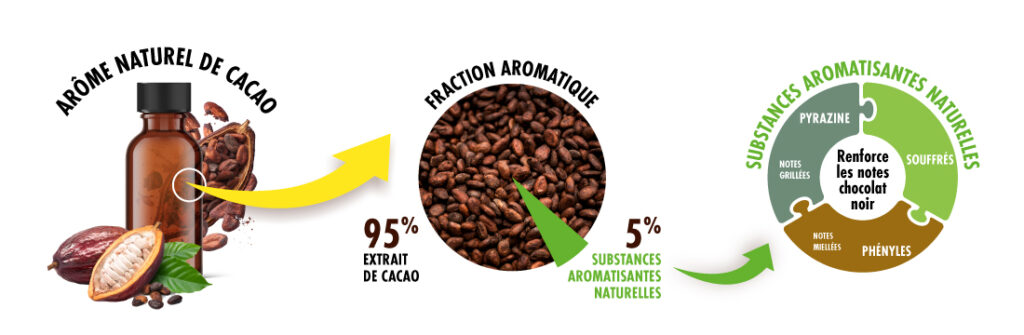
- "Natural flavors of X*": to use this designation, the flavor fraction must originate more than 95% from the source, and the taste of this source must be easily recognizable.
- "Natural flavors of X* with other natural flavors": this designation is possible when the flavor fraction contains less than 95% of the source, yet the taste is easily recognizable.
- "Natural flavors": when there is no specifically recognizable source.
For natural flavors of X* where the flavoring fraction is 100% derived from the source, it is customary to use the designation "extract of X*" as defined in ISO 9235:2013.
The packaging must provide the consumer with an accurate overview of the product's composition and its organoleptic properties.
PROVA has developed a regulatory document with the sole purpose of providing its clients with a daily working tool containing a compilation of various regulatory texts, practices, and professional recommendations. Under no circumstances should it be considered a substitute for official texts, which alone are authoritative and to which professionals are committed to refer at all times.
*X is the source providing the taste to the flavor; vanilla can be taken as an example.
*Y is the flavor profile of the flavor, for example, 'hazelnut'.